Gränsfors Bruks axes
Council Tool Axes
EnZo Knives
Fenix Lights
Berkey
Filters
Benchmade
Knives
Spyderco Knives
Goal
Zero Solar
Wiley
X eyewear
Slip 2000 Lubricants
Cool Accessories
Other
gear
Send an e-mail
Most orders
ship within 24 hours.
70% ship same day.
Do you own a small business? We support other small business. If you buy from us we want the opportunuty to return the favor. There are lots of things we want/need and lots of things we don't. But you won't know which if you don't contact us and offer.
Please e-mail with questions or visit the store to purchase.
$5.00 Shipping on all orders in the USA
Most orders ship within 24 hours. 70% ship same day. Priority mails get the order to you in 2-3 days
Council Tool axes are made in the USA. We carry a wide range of their axes at good prices with low and fast shipping.
The following information is from a personal viewpoint, based on observations, life experiences, and a small amount of information from Council Tool. I have worked in manufacturing in low level management therefore much of what I am sharing comes from there.
Most of our customers are picky. If they weren't they would just go to the hardware store and buy the junk made in China. We welcome the pickiness but sometimes deal with unrealistic expectations so I want to better explain the line so people are getting what they expect.
We were a Gransfors dealer long before Council Tool. Gransfors produces axes for the discriminating person who buys the axe for personal use. This person enjoys nice things and craftsmanship. Council Tool on the other hand makes "tools." They make axes for divisions of federal and state governments (i.e. Forest Service Military, etc). These contracts require tools that will be reliable and of good quality, but fancy details are not wanted.
Let me side track for a moment and say Council Tool has been increasing interest in finer axes and have created their Velvicut series to meet those needs. But what I am addressing is the rest of the product line.
A bit about manufacturing costs: manufacturing does what is called cost accounting. Every second of time, every screw, dab of paint, etc is accounted for and the proper amount assigned to each item. This also includes sand paper, grind wheel, and even garbage disposal. Once this cost is identified, through other analysis there is a percentage of mark up to the product that is required to come out ahead.
There is other anyalysis such as market analysis. Areas are adjusted such as optional parts, quality of materials, attention to detail, etc. Changes are then made in order to get a product to the specific target price. (On things like Velvicut these downward adjustments are not made, the price reflects the costs of the desired design.)
So the reason I am telling you this is because in the main line of Council Tool axes these compromises have been made, and I think made wisely. I'll run through them in no particular order:
#1 Aluminum wedge: Easier to insert quickly and correctly in a factory environment. They then smear some filler glue around to keep moisture from getting inside the head and done. This is absolutely good enough when buying axes for a work crew. Although in the opinion of most axe enthusiasts a wooden wedge is better because it compresses and gets a better fit that lasts longer. Plus it looks cooler.
#2 Polyurethane on the handles is really a must for work crews. For an enthusiast, we would rather maintain it with Linseed oil and have the bare wood against our skin. Same basic thing with paint on the head.
#3 Wood grain direction: You may have first learned of this on a baseball bat. The brand or label that is printed into wood should be facing you, right? That way the grain is in line with the ball for maximum strength. On an axe that same grain direction is preferred. Many people believe an axe handle with the grain not straight in line with the strike is substantially weaker. However, that is a bit misunderstood.
First off, technically the strongest is 10-15 degrees off straight. But that is not my point. We are talking about grain two dimensionally so far, but the real weakness occurs in the third dimension, where you have grain lines that do not run the full length of the bat or axe handle because they run slightly crossways. Don't confuse this with lines that end due to changes in thickness, I'm just talking about the core. You want the grain to run full length. So with full length grain, even if the grain is rotated to the "wrong way" on the end of the handle, it would take a scientific study to show a strength difference and they almost never split down the grain lines because of the orientation. An axe handle that is defective will split down the grain lines within the first couple of uses. If that did happen we would warranty it.
The US Forest Service knows a great deal about wood and axes and does not care about the grain direction when looking at the end of the handle. They only care about the grain running full length.
#4 Wood Color: Conventional wisdom is that darker wood is less strong because of the age (older) and because it comes from the core of the tree. This is true only to a point. It takes a really old tree for that to apply and the better handle makers will not use that really old core wood. The US Forest Service specifications accept the two toned or darker wood.
#5 Sharpness: Council Tool does not send out sharp axes. (Read about our free sharpening). Although they might explain it this way; different people want different types of edges so they let the customer decide. But I would guess it is just economics.
The labor cost to sharpen each axe well [in a factory environment] would add a lot to the cost of the axe. But that is only one element of the cost. A sharp axe is potentially dangerous from then on. So each axe would have to have a sheath and require additional packing. Sharpening and subsequent handling of finished product would take more time, slowing production or requiring more works and space to prevent a bottle neck. In this environment you would not be able to avoid an occasional bad cut to a worker. So workers comp rates skyrocket, and a new cost is added to your axe. NOTE: When we first picked up the line the samples of the Velvicut axes were sharpened pretty well. Since they come in a nice sealed box we initially did not offer to sharpen those. However we have since learned that they are commonly not sharpened very well.
#6 Steel & Heat Treatment: Council Tool uses 1060 steel on most of their axes and 5160 on their Velvicut series. 1060 would be considered an ideal steel for axe heads and 5160 even better than that. Heat treatments shoot for a degree of hardness that is good for edge holding but not so hard it will chip if it contacts a rock. I suppose there is danger from flying pieces of metal, but the bigger problem is a chip can take a lot of steel out and essentially ruin the head. Whereas, if a bit softer, the edge will bend and deform which will require resharpening. But the total damage is less. Axes in the Velvicut lines as well as the Forest Service contract axes are more precisely heat treated so they can be consistently harder without crossing the line.
#7 Axes are shipped to us 6 to a box. These axes touch each other and commonly leave minor rub marks somewhere on the axe, but have never had any real damage, but some buyers have commented on it. Any metal burrs on the head or at the wedge will be smoothed over when we sharpen it. When we do this we do not touch up the paint as it will get more scratches with each use.
#8 Grinding of the surface of the axe. It is commonly a bit wavy because it was done free hand on a production line. It is a detail that has been mentioned by customers but does not affect performance (update 2/11/13). We feel this is something that can be improved upon by asking the workers to try a little harder to be neat, so have asked Council Tool to consider it.
So, it comes down to tool or personaly trophy. For me, I'll take both. The tool to loan to others or to use when damage to the blade is possible (around rocks, wires,etc) and a trophy for my enjoyment.
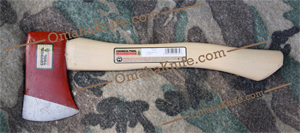
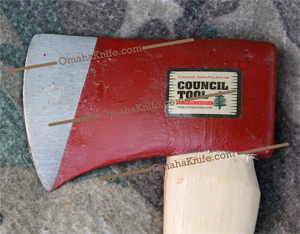
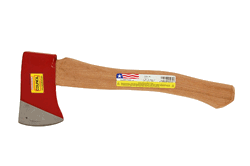
Dayton: 1.25# Hunter's Axe w/ 14" Handle
1.25 lb. Hunter's Axe with 14" curved hickory handle. Ideal for one-handed work and general camp chores. "Dayton" pattern originated from the Dayton, Ohio area.
In stock $24.95
$5.00 Shipping on all orders in the USA
Please e-mail with questions or visit the store to purchase.
PHOTO COMPARISON OF AXES HERE
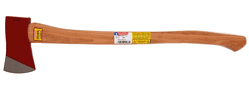
Dayton: 2.25# Boy's Axe w/ 28" Curved Handle
2.25 lb. Dayton axe head outfitted with a 28" curved hickory handle. Popularly referred to as a "boy's" axe. A "mid" sized tool. Dayton pattern originated from the Dayton, Ohio, area.
In stock $29.95
Please e-mail with questions or visit the store to purchase.
PHOTO COMPARISON OF AXES HERE
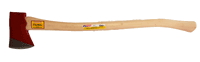
Jersey: 3.5# Jersey Axe w/ 32" Curved Handle
3.5 lb Jersey pattern single bit axe with a 32" curved handle. Sometimes referred to as a "Baltimore Jersey" pattern, this shape features lugs or ears which increase the surface contact area with the handle. The geographic origins are self explanatory. The earlier Kentucky and North Carolina patterns were somewhat similar. A full sized felling axe for general axe chores. Cutting edge is approximately 5” in overall length and the poll is square.
In stock $34.95
Please e-mail with questions or visit the store to purchase.
PHOTO COMPARISON OF AXES HERE
Jersey: 3.5# Jersey Axe w/ 36" Curved Handle
3.5 lb Jersey pattern single bit axe with a 36" curved handle. Sometimes referred to as a "Baltimore Jersey" pattern, this shape features lugs or ears which increase the surface contact area with the handle. The geographic origins are self explanatory. The earlier Kentucky and North Carolina patterns were somewhat similar. A full sized felling axe for general axe chores. Cutting edge is approximately 5” in overall length and the poll is square.
In
stock $34.95
Please e-mail with questions or visit the store to purchase.
PHOTO COMPARISON OF AXES HERE
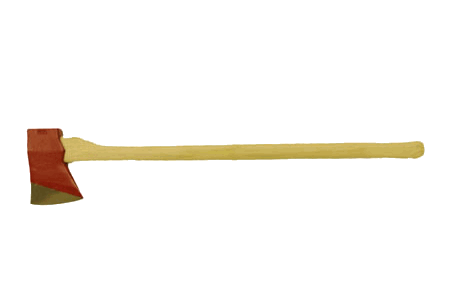
Jersey: 3.5# Jersey Axe w/ 36" Straight Handle
3.5 lb Jersey pattern single bit axe with a 36" straight handle. Sometimes referred to as a "Baltimore Jersey" pattern, this shape features lugs or ears which increase the surface contact area with the handle. The geographic origins are self explanatory. The earlier Kentucky and North Carolina patterns were somewhat similar. A full sized felling axe for general axe chores. Cutting edge is approximately 5” in overall length and the poll is square.
In stock $34.95
Please e-mail with questions or visit the store to purchase.
PHOTO COMPARISON OF AXES HERE
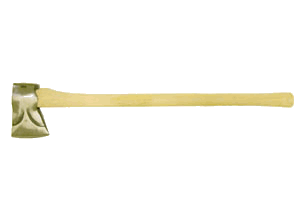
Jersey: 3.5# Jersey Classic w/ 36" Curved Handle
3.5 lb. Jersey pattern single bit axe with phantom bevels and a 36" curved handle. This shape features lugs or ears that increase the surface contact area with the handle. A full-sized felling axe for general axe chores.
In stock $47.95
Jersey: 3.5# Jersey Classic w/ 36" Straight Handle
3.5 lb. Jersey pattern single bit axe with phantom bevels and a 36" curved handle. This shape features lugs or ears that increase the surface contact area with the handle. A full-sized felling axe for general axe chores.
In Stock $47.94
Please e-mail with questions or visit the store to purchase.
PHOTO COMPARISON OF AXES HERE
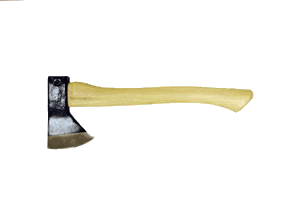
Hudson: 1.75# Hudson Bay Axe
1.75 lb. Hudson Bay Axe head outfitted with an 18" curved hickory handle. One-handed camp axe. Used for light splitting, chopping, driving tent pegs, etc. The pattern is thought to have originated from "Biscayan" in Northern Spain, near France. French traders used this hand axe as a trade tool in their dealings with Native Americans for fur and other commodities in the Hudson Bay area, St. Lawrence River, and other trade routes.
In stock $36.99
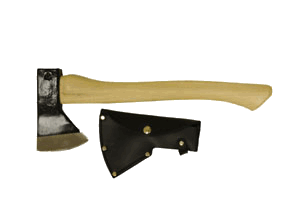
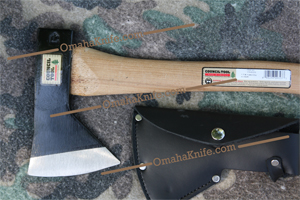
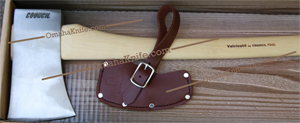
Hudson: 1.75# Hudson Bay Axe w/ Protective Sheath
1.75 lb. Hudson Bay axe head outfitted with an 18" curved hickory handle and furnished with a sheath. One-handed camp axe. Used for light splitting, chopping, driving tent pegs, etc. The pattern is thought to have originated from "Biscayan" in Northern Spain, near France. French traders used this hand axe as a trade tool in their dealings with Native American for fur and other commodities in the Hudson Bay area, St. Lawrence River and other trade routes.
In stock $49.95
Please e-mail with questions or visit the store to purchase.
PHOTO COMPARISON OF AXES HERE
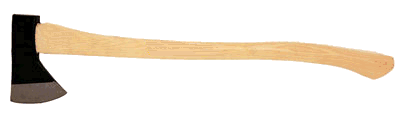
Hudson: 1.75# Hudson Bay Camp Axe
1.75 lb. Hudson Bay Axe head outfitted with a curved hickory handle. Two-handed camp axe, 26" overall length . Used for light splitting, chopping, driving tent pegs, etc. The pattern is thought to have originated from "Biscayan" in Northern Spain, near France. French traders used this hand axe as a trade tool in their dealings with Native Americans for fur and other commodities in the Hudson Bay area, St. Lawrence River, and other trade routes.
In stock $49.95
Hudson: 1.75# Hudson Bay Axe w/ 28" Handle w/ Sheath
1.75 lb. Hudson Bay Axe head outfitted with a curved hickory handle with a leather sheath. Two-handed camp axe, 26" overall length . Used for light splitting, chopping, driving tent pegs, etc. The pattern is thought to have originated from "Biscayan" in Northern Spain, near France. French traders used this hand axe as a trade tool in their dealings with Native Americans for fur and other commodities in the Hudson Bay area, St. Lawrence River, and other trade routes.
In stock $59.95
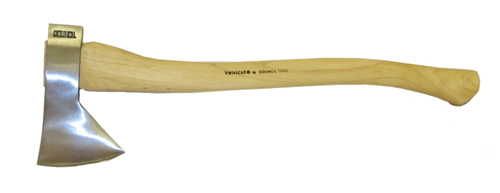
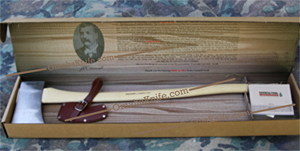
Velvicut 2# Premium Hudson Bay Axe
The Velvicut® line of products represents Council Tool's finest accomplishment in the axe making craft. This 2lb Hudson Bay Premium Velvicut® axe is a shape and size ideal for any camping, hunting or hiking expedition. We forge the head from 5160 alloy steel, and it will outlast any user – we guarantee it! The Hudson Bay is small enough to pack and carry yet big enough to get the job done. 2# head plus the wood handle combines for an overall tool weight of approximately 2-3/4 lbs.
In stock $129.95
Please e-mail with questions or visit the store to purchase.
PHOTO COMPARISON OF AXES HERE
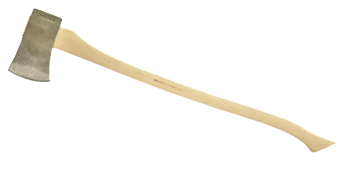
Velvicut 4# Premium American Felling Axe
The Velvicut® line of products represents Council Tool's finest accomplishment in the axe making craft. This 4# heriloom American felling axe was produced by our most experienced artisans. The Dayton pattern is a timeless shape and much preferred by skilled woodsmen for a full-sized felling axe. The grade "A" hickory handle is selected for grain orientation and density. After the head is forged, much care is taken in the finishing process of our premium axe. The axe head is rough ground in a robotic work cell and then sharpened by an experienced craftsman using increasingly fine abrasives and then finished with leather stropping. A sharp axe is a safe axe as it is less likely to glance out of the cut. Be assured that this axe has been hand-honed razor sharp by our skilled craftsmen. Use caution when handling this axe, it is sharp! All components are MADE IN THE USA.
In stock $169.95
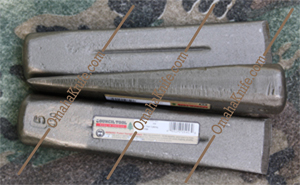
5# Wedge 5W
Drop Forged from American high carbon steel, wedges are properly beveled around the "struck" face to deter chipping and cracking. Designed to split logs, firewood, staves and other wood products. Sharpened and ready to use, the Council wedge is tapered for efficient splitting. Coated with a clear lacquer finish.
In stock $23.00
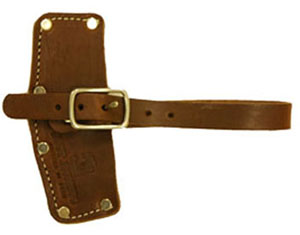
Single Bit Axe Sheath
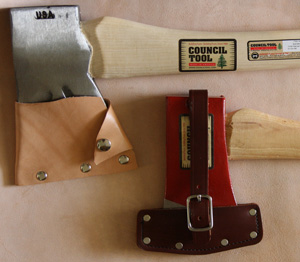
Leather bit guard for single bit axe. This sheath fits our 3.5 & 4# Dayton patterned axes as well as the Boys Axe. Sheath is made of quality leather with stitching, rivets and a buckle that fastens around the base of the axe head. Council Tool Company is embossed in the leather. Sheath is Made in the USA. This bit guard fits the following Council Tool products:
22BR
35MD20
35MD26
35DR36S
35DR36C
35DRFG
40MD20
40DR36C
40DR36
In stock $16.00
Council Tool replacement axe handles
Replacement handles for Council Tool axes are $16.00 each for any size. Velvicut Models are $28.00 (plus s/h)
We carry the full gransfors Bruks line please e-mail for items not listed or to order any product.
$5.00 Shipping on all orders in the USA
NOTE: We are a small shop please e-mail with questions or visit the store to purchase.
|
|
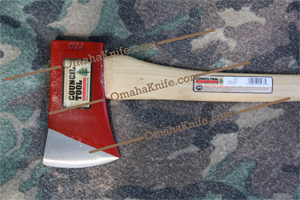
Council Tool 125HU |
Council Tool 125HU |
1.25lb Hunter's Axe(Hatchet) w/ 14" Curve Handle |
1.25lb Hunter's Axe(Hatchet) w/ 14" Curve Handle |
 |
 |
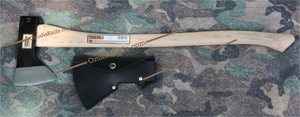
Council Tool 175HBS18 |
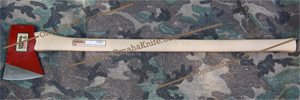
Council Tool 35JR36S |
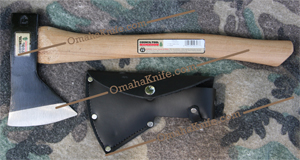
1.75lb Hudson Bay w/ Sheath |
3.5lb Jersey Axe w/ Straight Handle |
 |
 |
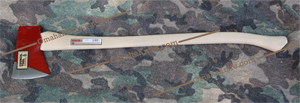
Council Tool 35JR36C |
|
3.5lb Jersey Axe w/ Curved Handle |
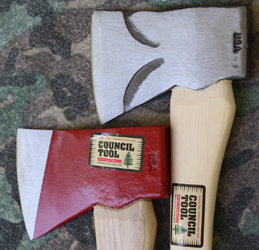
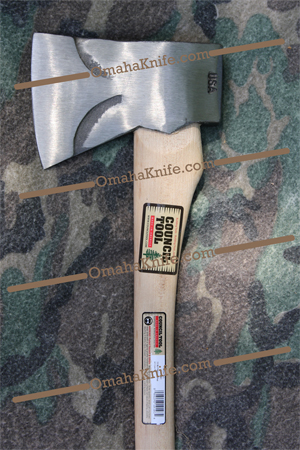
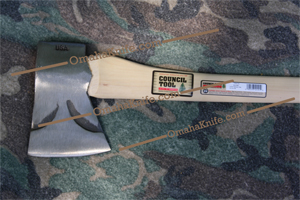
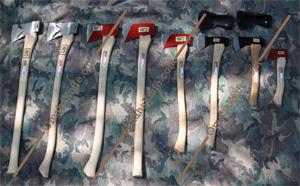
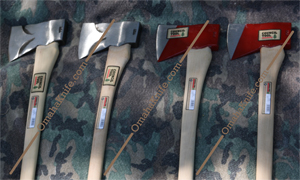
Red head series and classic series differences illustrated here. Classic series has smooth finish over entire head and beavels to minimize jamming. |
 |
 |
Council Tool 35JC36C |
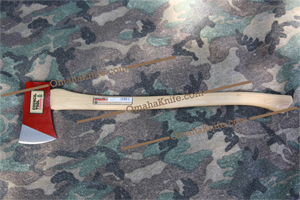
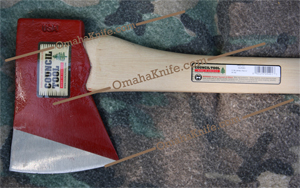
Council Tool 22BR 2.25lb Axe w/ 28" Curve Handle |
 |
 |
Council Tool 35JC36S |
Council Tool 35JC36S |
3.5lb Classic Axe w/ Curved Handle |
3.5lb Classic Axe w/ Curved Handle |
 |
 |
Council Tool JP40DV36C |
Council Tool JP40DV36C |
Velvicut premium 4lb Axe w/ 36"
Curved Handle |
Velvicut premium Axe w/ 36" Curved Handle |
 |
 |
 |
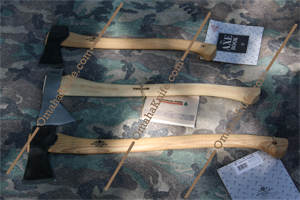 |
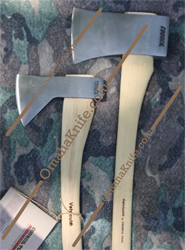
| Velvicut Premium axes. 2lb hudson bat and 4lb American Felling axe | Velvicut Premium Hudson bay between Gransfors Bruks Small forest axe and Scanadinavian forest axe |
 |
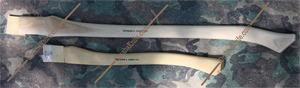 |
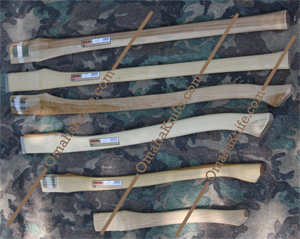
Council
tool replacement axe handles |
Velvicut premium handles |
 |
 |
Custom sheath VS. Council Tool sheath |
Council Tool 175HBS18 |
1.75lb Hudson Bay w/ Sheath |
|
 |
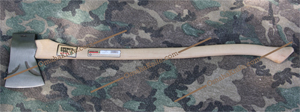 |
Council Tool 35JR36S |
Council Tool 35JC36C |
3.5lb Jersey Axe w/ Straight Handle |
3.5lb Classic Axe /w Curved Handle: Classic has bevel cut into the fact to minimize jamming. Has a smoother finished steel on entire head vs models with red painted heads |
 |
 |
Council Tool 22BR |
Council Tool 175HB28 |
2.25lb Axe w/ 28" Curve Handle |
1.75lb Hudson Bay w/ 28" Curved Handle |
 |
 |
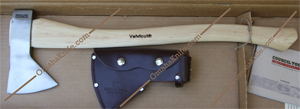
Council Tool JP20HB24C |
|
Hudson Bay Velvicut Premium Axe w/ 24" Curved Handle |
|
 |
 |
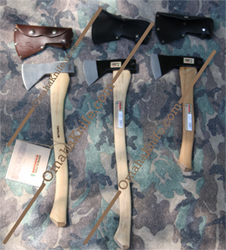
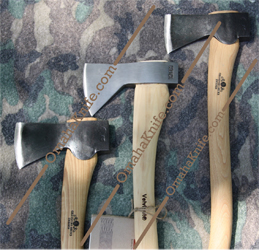
Velvicut Premium Hudson Bay between Gransfors Bruks Small Forest Axe and Scandanavian Forest Axe |
Council Tool Wood Splitting Wedges |